

Hybrid heat pumps: The ultimate solution for decarbonising homes in Spain and Italy?
Decarbonising residential heating is one of Europe’s biggest energy challenges, as heating and hot water account for more than 50% of the continent’s final energy consumption. A new international study, involving researchers from the Universitat Politècnica de València (UPV), analyses how Hybrid Heat Pumps (HHPs) can accelerate this transition without the need for comprehensive building renovations.
📘 «Economic and environmental assessment of hybrid heat pumps: a cross-country analysis»
👥 Authors: Eva Schito, Paolo Conti, Daniele Testi, Carla Montagud-Montalvá, José-Luis Vivancos
📍 Journal: Energy & Buildings (Elsevier)
🔗 DOI: https://doi.org/10.1016/j.enbuild.2025.116857
The hybrid system: The best of both worlds
An HHP combines an electric air-to-water heat pump with a natural gas condensing boiler. This system allows the heat pump to operate efficiently in moderate conditions, while the boiler kicks in to meet peak demand or provide high-temperature water in existing buildings with conventional radiators.
Main contributions of the study
The research stands out for its practical and statistical approach, using a “building stock” model based on national census data to ensure that the results are representative:
-
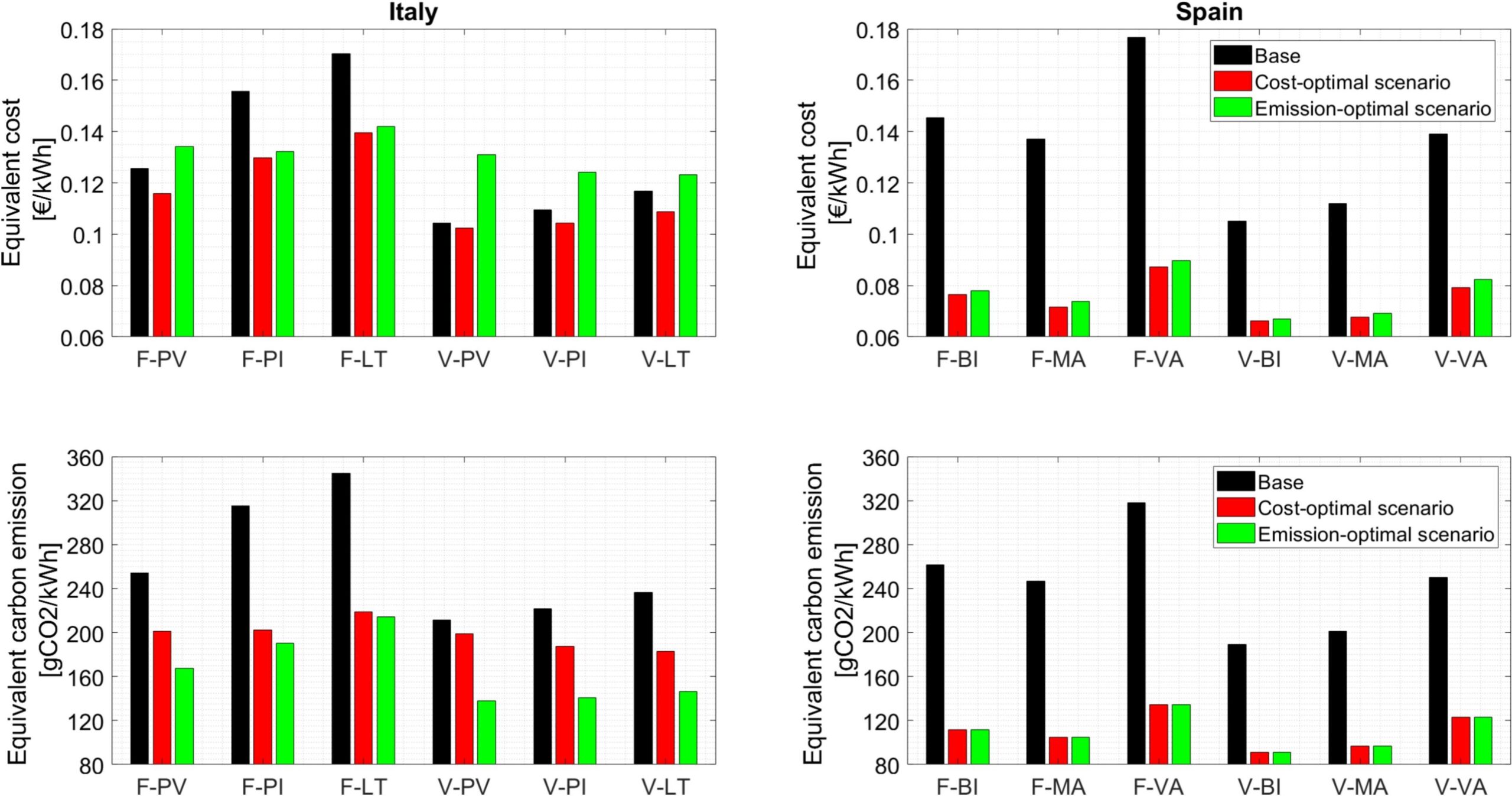
Dynamic analysis: Heating and domestic hot water (DHW) loads have been simulated hour by hour in six representative cities: Bilbao, Madrid and València in Spain; and Pavia, Pisa and Latina in Italy.
-
Impact of DHW: The study identifies hot water demand as a critical factor in system performance, as it directly influences sizing decisions and boiler efficiency.
-
Control comparison: Basic strategies (based on outdoor temperature) are evaluated alongside “ideal” controls to quantify the margin for improvement compared to current commercial systems.
Results: A contrast marked by the energy mix
The study reveals that the economic and environmental viability of this technology depends drastically on the context of each country:
-
In Spain: Thanks to an electricity mix with a high presence of renewables and nuclear power, hybrid pumps achieve operating cost savings of up to 50% and a reduction in emissions of up to 60% compared to the exclusive use of boilers.
-
In Italy: Savings are more moderate (up to 20% in costs and 30% in emissions) due to greater dependence on natural gas for electricity production and a different pricing structure for residential consumers.
Towards a smart transition
The study concludes that hybrid heat pumps are an exceptional transition technology. They enable immediate, realistic decarbonisation, as they do not require users to change their emitters (radiators) or make large initial investments in insulation to achieve positive results.
For policymakers and designers, the work highlights a key lesson: there is no one-size-fits-all solution. The success of the hybrid heat pump depends on accurate sizing and electricity tariffs that incentivise the electrification of heat over the consumption of fossil fuels.



