

DOWNLOAD THE COMPLETE WORK HERE.
Growing concern about climate change and the need to reduce greenhouse gas emissions are driving a global transformation towards renewable energy. In this context, Emmanuel Jean Daniel Pic Munuera has developed, under the supervision of Paula Bastida Molina and Tomás Gómez Navarro, the Final Degree Project entitled ‘Design of an algorithm for the optimisation of the installation of photovoltaic solar panels and the calculation of large-scale solar potential in urban environments’, presented at the Polytechnic University of Valencia. This project tackles one of the greatest challenges facing modern cities: how to make the most of the energy resources available in densely populated areas.
The objective of the work was to design an automated methodology to evaluate the solar potential of large urban areas, using advanced technologies such as artificial vision and geospatial analysis. The research was applied specifically to the Illa Perduda neighbourhood in Valencia, which has been recognised as a model of sustainability by being designated part of the European Green Capital 2024. This case study demonstrated how technological advances can be integrated into urban planning to create more sustainable cities.
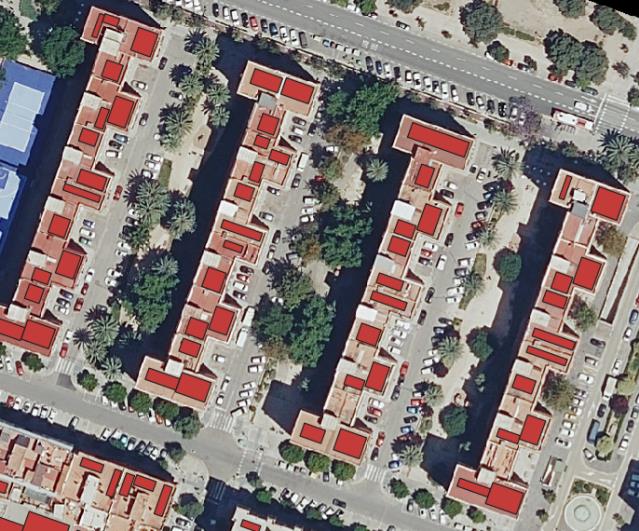
The algorithm developed by Pic Munuera incorporates tools such as MATLAB and QGIS, and is fed by data from high-definition orthophotos, LIDAR files and cadastral databases. This data makes it possible to identify suitable surfaces for the installation of solar panels, automatically discarding those that do not meet the criteria of irradiation, orientation or inclination. Once the viable areas have been identified, the algorithm optimises the layout of the solar panels to maximise energy generation, considering parameters such as projected shadows, ideal inclination (around 35°) and the most efficient orientation.
The results obtained at Illa Perduda are an example of the potential of this methodology. A usable surface area of 21,159 m² was identified, capable of generating 4.45 GWh per year. This level of production is equivalent to covering the energy needs of hundreds of homes, with a positive environmental impact thanks to the reduction in carbon emissions. In addition, the study revealed that panels with a higher nominal power rating do not always generate more energy, and that a south-facing orientation is not always the most efficient in terms of making the most of the available space.
One of the most innovative aspects of the project is its focus on automation and scalability. Unlike traditional methods that are often limited to rough calculations or manual analyses, this algorithm allows for accurate large-scale assessments in a short period of time, opening the door to its application in other cities and regions. This ability to adapt to different urban contexts makes this methodology a key tool for planners and public policy makers seeking to integrate renewable solutions into their development strategies.
The impact of this work is not limited to its technical contribution. It is also aligned with global objectives such as the 2030 Agenda and the European Green Deal, which seek to reduce emissions by 55% by 2030 and achieve climate neutrality by 2050. In addition, it promotes the idea of the ‘prosumer’, citizens who not only consume energy, but also produce it, which reinforces energy self-sufficiency and reduces dependence on fossil fuels.
This project reflects the commitment of the Polytechnic University of Valencia and the Chair of Urban Energy Transition to training professionals capable of leading the transition to a sustainable future. Emmanuel Pic Munuera, together with his tutors, has demonstrated how applied research can offer real solutions to global problems, integrating technology, sustainability and urban planning.
The methodology developed not only optimises the use of resources, but also promotes an inclusive and efficient energy transition, demonstrating that innovative solutions are essential to face current climate challenges. This work inspires academics, urban planners and public policy makers to rethink how cities can lead the change towards a cleaner and more sustainable energy model.
You can check this work here.



