

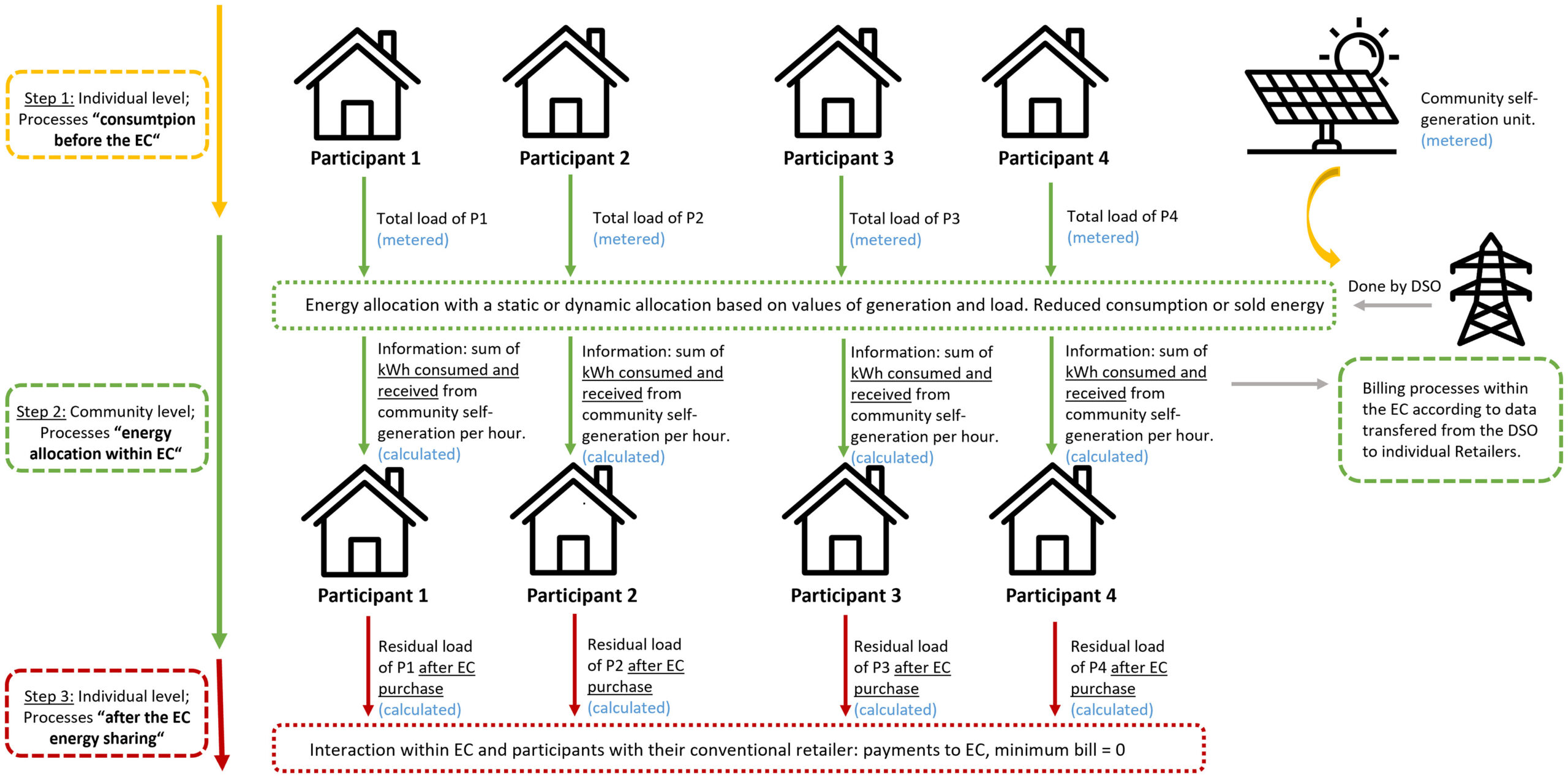
Despite common regulatory guidelines at the European level, national transpositions of legislation have resulted in significant differences in the operation of Renewable Energy Communities (RECs). A new study by researchers from the AIT Austrian Institute of Technology and the Universitat Politècnica de València (UPV) analyses how national laws determine the technical and economic success of these communities.
📘 «Quantifying the regulatory impact on Renewable Energy Community performance in Austria and Spain»
👥 Authorship: Bernadette Fina, David Ribó-Pérez, Álvaro Manso-Burgos
📍 Journal: Energy Policy (Elsevier)
🔗 DOI: https://doi.org/10.1016/j.enpol.2026.115187
Methodology: Swapping legal frameworks
The research uses an innovative methodological approach based on scenario swapping: the performance of a typical Austrian REC is evaluated under Spanish regulation, and conversely, a Spanish REC is analysed under the Austrian legal framework. The study quantifies the impact of critical variables, including energy allocation coefficients, geographical constraints, grid tariffs, and financial support schemes.
Results: Energy, economic, and ecological indicators
The comparative analysis reveals significant contrasts across the three key indicators analysed:
-
Energy Performance: Austrian legislation leads to higher rates of self-consumption and self-sufficiency. Its regulatory design incentivises superior technical optimisation of energy generated locally within the community.
-
Economic Viability: Conversely, the Spanish legal framework increases the economic viability of RECs compared to the Austrian one. Compensation mechanisms and tariff structures in Spain result in more favourable financial indicators for community members.
-
Ecological Impact: In both countries, the formation of RECs contributes to reducing CO2 emissions. However, the impact degree varies depending on the carbon intensity of the national electricity mix and incentives to displace grid consumption.
Policy Implications
The study concludes that legislative details are decisive: while the Austrian model prioritises system energy efficiency (self-consumption), the Spanish model facilitates investment profitability. These findings provide an essential scientific basis for regulators to adjust policy frameworks, seeking a balance that ensures both technical robustness and economic attractiveness for citizens.
This work aligns with the CATENERG Chair’s strategic line dedicated to the simulation and optimisation of Renewable Energy Communities to advance towards climate neutrality.



