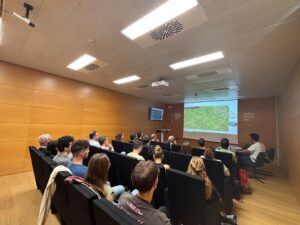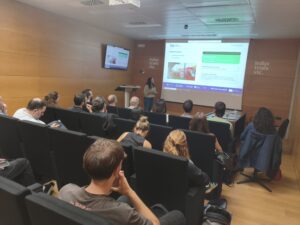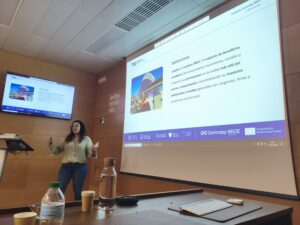
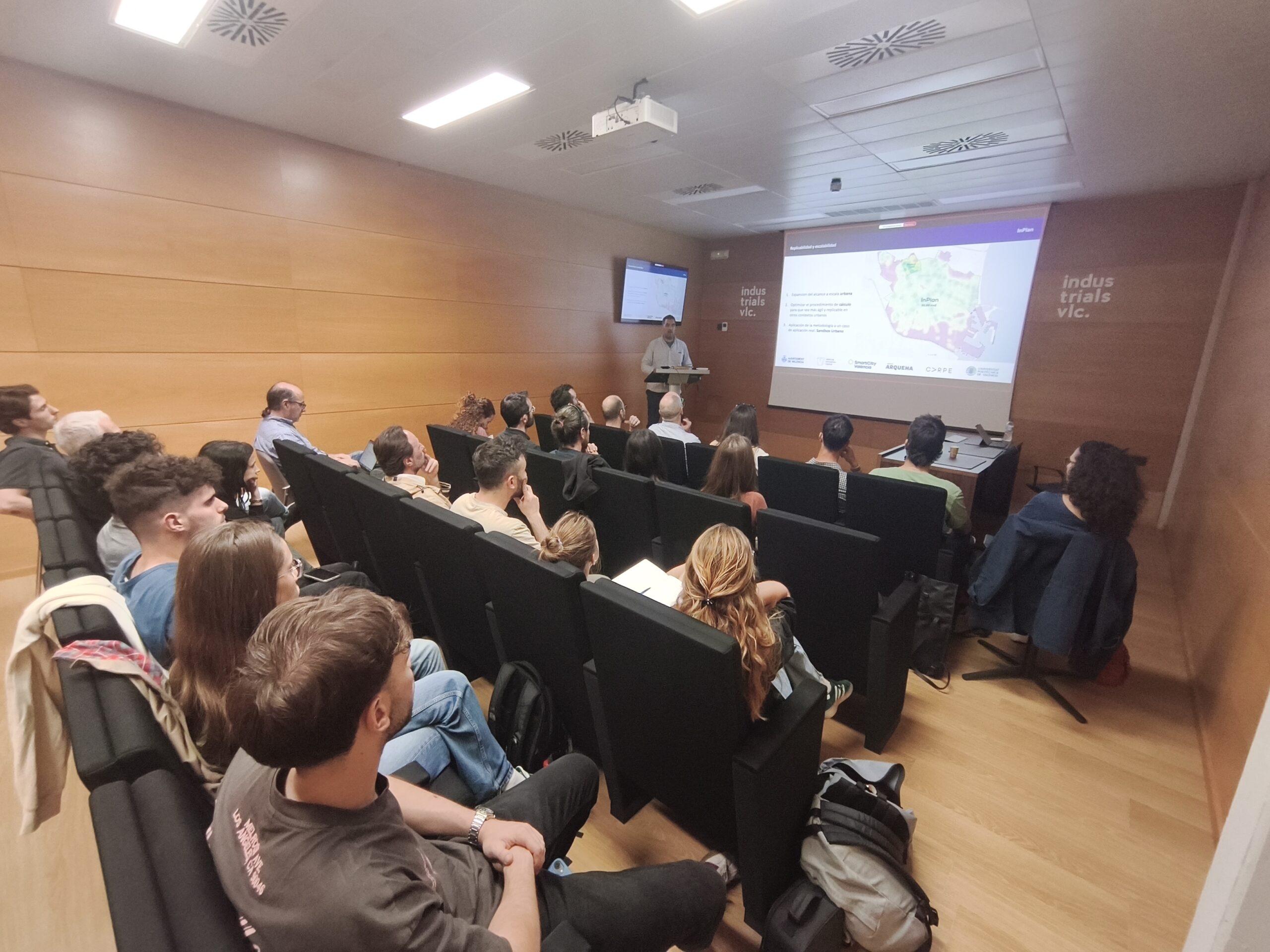
Last Thursday, April 23rd, the Chair on Urban Energy Transition at UPV successfully held the Knowledge Transfer Seminar: Urban Planning and Data Management. This space, designed to connect cutting-edge academic research with municipal public management, focused on exploring technological solutions to address the challenges of the climate emergency, in full alignment with the decarbonisation goals of the Missió València 2030.
📋 An Overview of Urban Decarbonisation Tools
During the event, we had the privilege of learning about the latest advances in modelling, simulation and territorial planning applied to urban environments. The programme of presentations addressed the main lines of research of the Chair and its collaborators:
- The driving role of the public sector (Bilbao Case Study): From Tecnalia, Pablo de Agustín and Patxi Hernández opened the session by showing how Bilbao’s Energy Action Plan aims to reduce energy consumption by 35% by 2030. Their tool Heatzone illustrated how to map residual heat and renewable potential for decision-making.
-
InPlan (Plan.0) – Data-driven Urban Planning: Ignacio Enrique Guillén, José Alapont and Javier Bono (UPV) presented the evolution of InPlan. They showed how this urban planning digital twin has reached a technology readiness level (TRL 9), enabling unprecedented scalability through the integration of geospatial databases and QGIS.
-
Extreme Microclimatic Modelling with PalmQ10: Adriana Ramírez Cuebas and Javier Orozco Messana (UPV) immersed us in advanced simulation. They presented PalmQ10, a high-fidelity workflow using the PALM system to assess urban thermal comfort (UTCI) and wind flows under extreme heat events, already validated in the Ciutat Vella area.
-
Multimodal Transport Network (Nearcity and ARIADNA Projects): Aida Villalba and José Miguel Carot (UPV) detailed the design of a big data infrastructure (ETL process based on GTFS and OpenStreetMap) capable of modelling active and public transport networks in the València Metropolitan Area, a key component for sustainable mobility.
-
Zentropy MICE Project: Mireia Roncero, Iuliia Ritck, Tomás Gómez Navarro and José Miguel Carot (UPV) closed the seminar with a disruptive approach to reducing the “urban entropy” of congress tourism. Their proposal seeks to have the MICE sector offset its impact through efficient energy management, material circularity and knowledge transfer, leaving a positive legacy in the city.
📅 Event Details Summary
-
Date: Thursday, April 23rd
-
Time: 12:00 – 14:00
-
Venue: Sala Alfa, School of Industrial Engineering (ETSII), UPV. Second floor of building 5F.
-
Format: In-person
📥 Materials and Presentations
We are deeply grateful to all attendees and speakers for their active participation and for enriching the debate on the energy future of València. Knowledge transfer is the bridge to fairer, more efficient cities.
For all those who could not attend or wish to review the content presented, all materials are available for you:
👉 Access and download all seminar presentations here