

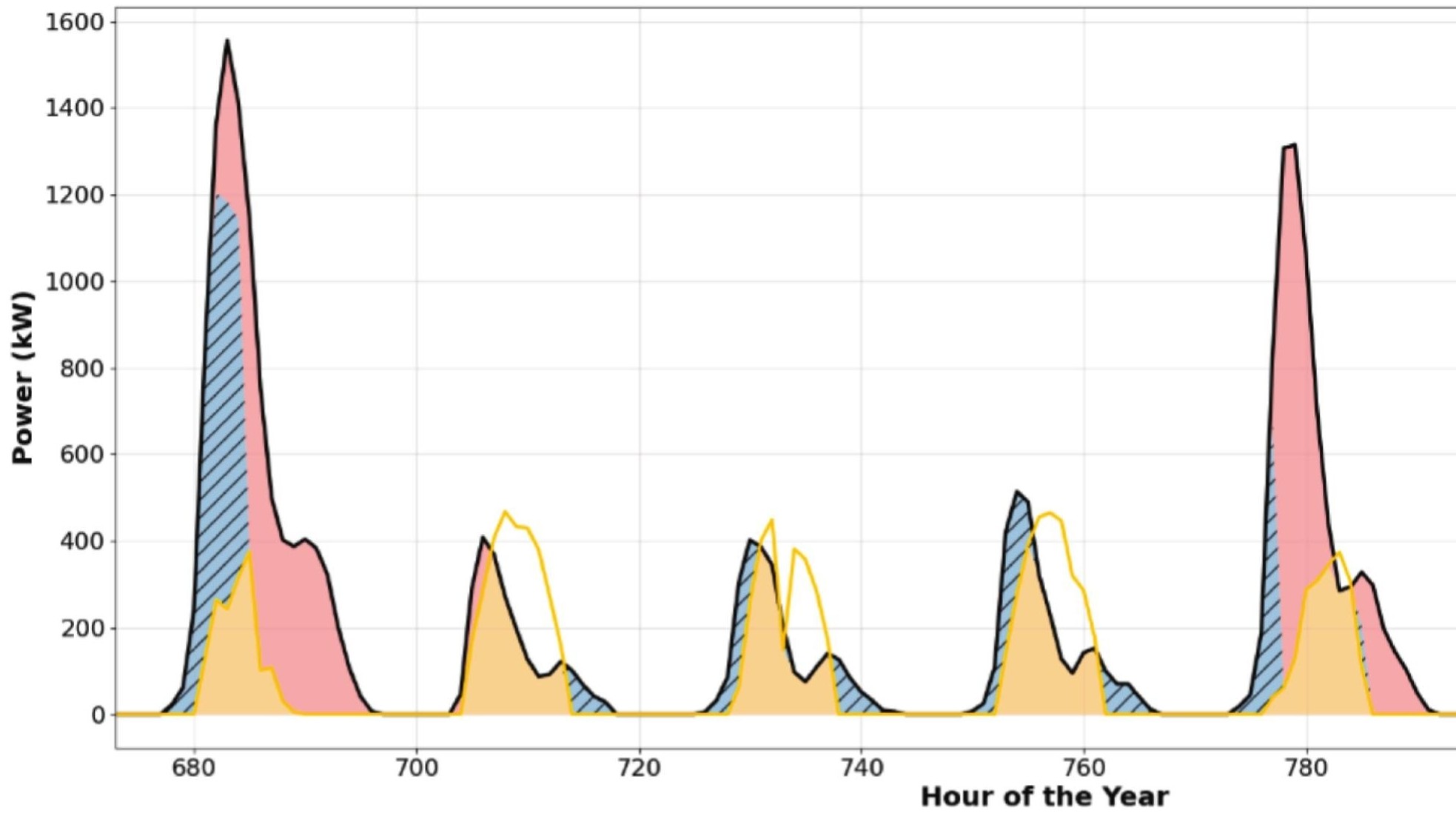
The electrification of transport is a fundamental pillar for achieving climate neutrality in cities, but its mass integration poses a technical challenge for energy systems dominated by intermittent renewable sources. A new study, led by researchers from the CATENERG Chair, proposes an innovative methodology to optimise and size electric vehicle (EV) charging infrastructure in workplace environments using solar photovoltaic energy.
📘 «Statistical energy-based sizing of electric vehicle charging infrastructure for workplace parking facilities: case study of Polytechnic University of Valencia, Spain»
👥 Authors: David Blanco-Muelas, Paula Bastida-Molina, César Berna-Escriche, Lucas Álvarez-Piñeiro, Carla Montagud-Montalvá
📍 Journal: Energy Conversion and Management: X (Elsevier)
🔗 DOI: https://doi.org/10.1016/j.ecmx.2026.101994
Methodology: Statistical Uncertainty and Stochastic Simulation
The research evaluates a real underground car park at the Ciudad Politécnica de la Innovación (CPI) of the UPV, with a capacity of over 600 vehicles. The main innovation of the study lies in the application of the BEPU (Best Estimate Plus Uncertainty) methodological framework combined with the Wilks statistic. This approach enables the propagation of real uncertainties within the energy ecosystem —such as the variability of solar generation, mobility habits, parking duration, and the state of charge (SoC) of batteries upon arrival— to obtain robust confidence bounds for energy demand and power requirements.
Results: Balance Between Technical Capacity and Economic Viability
The comparative analysis yields decisive conclusions for the design of these systems:
-
Charging Optimisation: The study demonstrates that a moderate charging power (7.4 kW) combined with smart charging strategies is the most balanced solution to reduce electrical infrastructure requirements without penalising the level of service to users.
-
Energy Performance and Storage (BESS): Although the analysed photovoltaic installation could theoretically cover up to 80% of annual charging demand, temporal mismatches limit direct self-consumption. The incorporation of battery energy storage systems (BESS) significantly raises the self-consumption ratio to 79–80% and the system’s energy self-sufficiency to 61–63%, drastically reducing dependence on the electricity grid.
-
Economic Viability: While the purely photovoltaic system proves highly profitable (with a payback period of 9 years and a Levelised Cost of Energy of €0.08/kWh), the current addition of commercial-scale batteries is economically unviable under standard tariff structures. To financially justify storage, the active participation of these systems in ancillary markets would be imperative.
Conclusions for the Urban Energy Transition
The study shows that simplified annual extrapolations tend to overestimate demand if stochastic models analysing real user behaviour are not applied.These findings provide a scalable and well-founded tool for urban planners and municipal authorities to design resilient and cost-effective charging ecosystems.
This work is directly aligned with the strategic line of the CATENERG Chair focused on Energy Modelling and Simulation, developing advanced algorithms for the location, sizing of public charging infrastructure, and management of hybrid systems.



