

The year 2025 has marked a milestone of maturity and technical consolidation for the Chair of Urban Energy Transition at UPV. During this period, we have had the pride of mentoring and witnessing the talent of new generations of engineers crystallize through 9 Final Degree Projects (6 Master’s and 3 Bachelor’s).
Far from remaining in a purely academic sphere, these research projects have tackled real and urgent challenges facing the city of València. From mitigating energy poverty in Parque del Oeste, to designing digital twins for historic buildings and creating decarbonised reconstruction plans for our neighbourhoods. Today we celebrate the efforts of these students who, with their technical rigour and social commitment, are providing the data intelligence needed to achieve the Missió Climàtica València 2030.
Knowledge open to the service of the city
True to our commitment to open science and technology transfer, we are making the complete documents of these 9 projects publicly available in UPV’s institutional repository Riunet. Below, we highlight the most relevant findings of each research project, structured around our main lines of work:
1. Strategic Planning and Decarbonisation at Urban Scale
For a city to achieve climate neutrality, it must first understand how it consumes energy and how it can generate its own. In this area, five projects have assessed the potential of different districts of València:
- Zaira Tapia Sinesio (Bachelor’s Thesis): “Methodology for the estimation and mitigation of CO₂ emissions in scopes 1 and 2 in urban environments: the case of La Torre neighbourhood”. She calculated an emissions inventory of 5,190.61 tCO₂ for Scope 1 and 1,493.67 tCO₂ for Scope 2. Her mitigation plan, based on electrification and solar photovoltaic energy, achieves an annual reduction of 1,839.41 tCO₂ by 2040. Read on Riunet.
- Juan Carlos Manzanilla Ku (Master’s Thesis): “Calculation of the potential of urban-scale rooftop solar photovoltaic installations to optimise electricity generation”. He developed an AI model that has successfully identified 2,670,079 m² of suitable rooftops in València, estimating a potential installed capacity of 173 MW and annual generation of 270 GWh, demonstrating that 78% of the modules could be located on flat roofs. Read on Riunet.
- Mohamed Moussa Aoudi (Master’s Thesis): “Assessment of the potential for implementing photovoltaic facades in the Benicalap district”. He evaluated the technical and economic feasibility of integrating photovoltaic systems into building facades, demonstrating how harnessing vertical surfaces can significantly increase renewable energy generation capacity in high-density districts where roof space is limited. Read on Riunet.
- Meriem Benabbou (Master’s Thesis): “Developing a positive energy district: Methodology and application to Benicalap scope 1 and 2”. She mapped out a comprehensive roadmap to transform Benicalap into a Positive Energy District, achieving projected reductions of 13,028 tCO₂ per year by 2040 through the integration of photovoltaics, sustainable mobility and building renovation. Read on Riunet.
- Bjorn Jansen (Master’s Thesis): “Techno-economic assessment of an on-shore power system fueled by green hydrogen: application to the port of Valencia”. He brought the energy transition to the maritime sector, assessing the implementation of an innovative On-Shore Power Supply system powered by green hydrogen to decarbonise port operations. Read on Riunet.
2. Energy Communities and Social Justice
The energy transition will only be a success if it is fair and leaves no one behind, transforming subsidies into long-term efficiency solutions:
- Nerea Tapia Sinesio (Bachelor’s Thesis): “Assessment of energy communities based on photovoltaic installations as a measure to mitigate energy poverty. Case study on pre-existing pergolas in Parque del Oeste, to supply 46 real vulnerable households.” Her analysis demonstrated, both technically and economically, that the use of municipal pergolas, combined with battery systems of 75-90 kWh, improves profitability and resilience compared to traditional non-repayable direct subsidies. Read on Riunet.
3. Energy-Efficient and Smart Buildings
Our public and university buildings must act as living laboratories (Living Labs). Three research projects have laid the foundations for their technological modernisation:
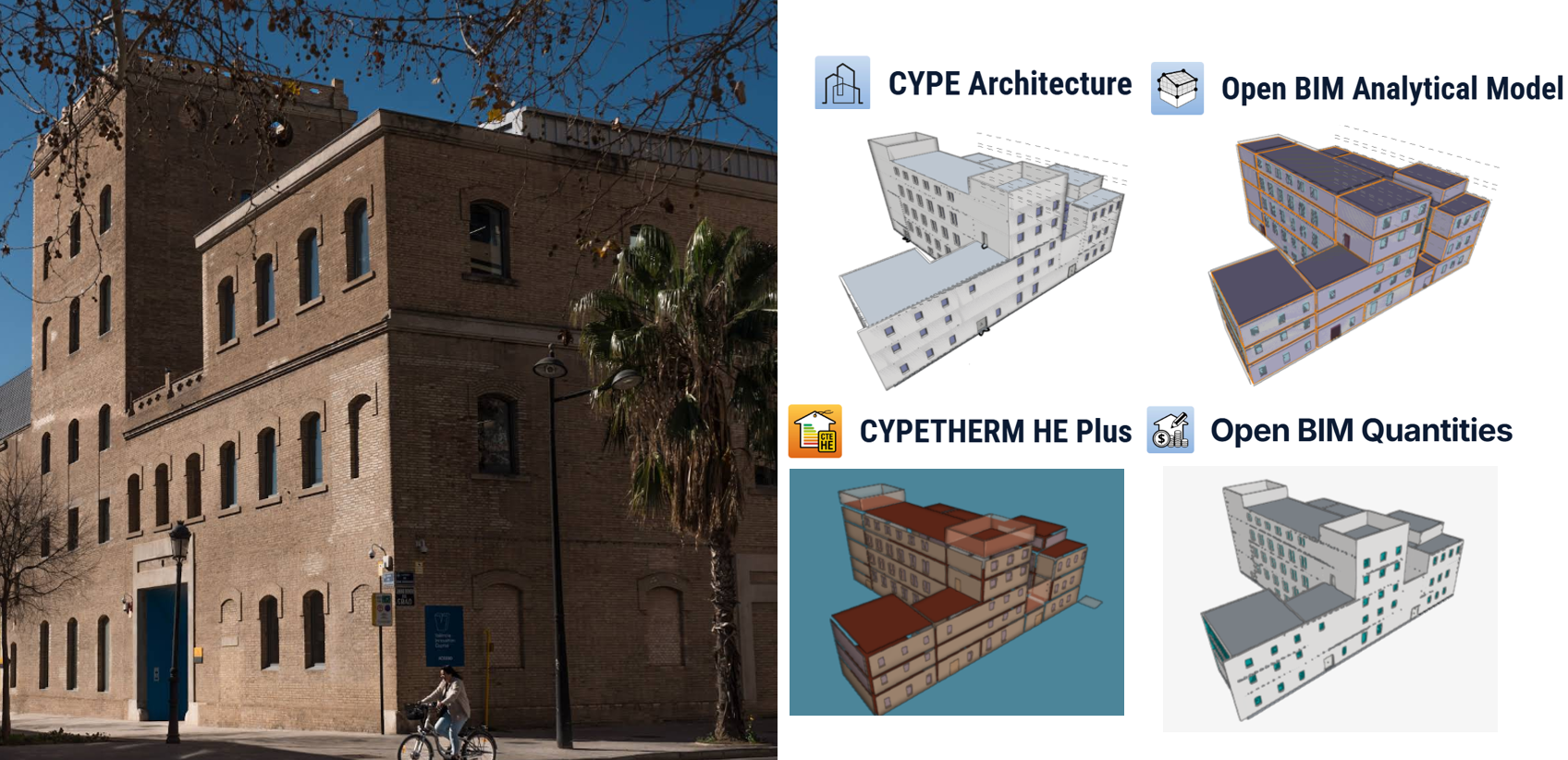
- Mónica González de Juan (Master’s Thesis): “BIM Project for NZEB Energy Optimisation at La Harinera”. She applied the Open BIM methodology and CYPE software to audit this municipal building. Her model analysed combined passive measures, such as night-time ventilation and solar shading, successfully reducing the energy consumption of a heritage asset and bringing it closer to the Nearly Zero Energy Building (NZEB) standard in a viable way. Read on Riunet.
- Amparo Calvete Sala (Bachelor’s Thesis): “Design of a progressive heat pump implementation plan to contribute to the decarbonisation of thermal demand at the Vera campus of the Universitat Politècnica de València”. She structured an ambitious phased plan to replace fossil-fuel boilers with high-efficiency aerothermal and geothermal systems, mapping out a comprehensive roadmap to achieve a carbon-neutral campus at UPV. Read on Riunet.
- Melchior Hahn (Master’s Thesis): “Simulation-Based Assessment of Energy Performance in the ETSII’s 5N building using TRNSYS”. He developed and validated a 3D model of the ETSII’s 5N building within the framework of UPV’s Living Lab project. He evaluated more than 81 simulated scenarios in TRNSYS, demonstrating that optimising setpoint temperatures and ventilation rates based on actual occupancy is vital for aligning HVAC system electricity consumption with demand, laying the analytical foundations for the development of university Digital Twins. Read on Riunet.
From academic research to public policy
From the Chair, we would like to extend our most sincere congratulations to the students and their supervisory teams. The rigour of these nine projects demonstrates that the young talent at the Universitat Politècnica de València is an indispensable driver of technical innovation for the City Council and the Valencian energy ecosystem.
The Chair’s work does not stop at academic publications. The results of these research projects directly inform the deliverables, audits, and strategic tools we transfer to the city of València.
💡 Would you like to find out how we translate this data into concrete actions and regulations?
We invite you to read our latest “2025 Proposals Report: Towards Urban Sustainability”, a strategic document compiling key technical recommendations to guide the city’s urban transition.
Download the 2025 Proposals Report
You can also follow the day-to-day progress of our pilot projects and the latest developments on our LinkedIn profile. Join us in building a more efficient, sustainable and socially just València!



